Coding for kids from age 7: where to start so it teaches thinking
How do you start coding with a 7-year-old? Order of steps first, then decisions and loops. A practical plan for parents, unplugged games and examples from the Looponi app.
Updated:
Coding for young children doesn't start with code. It starts with the question “what should happen, in what order?”. A seven-year-old who can plan getting ready for school is already thinking algorithmically — they just need a tool where that plan comes to life.
Order first, the rest later
A good learning order looks like this:
- Sequence — steps run one after another, and changing the order changes the result.
- Decision — the program asks a YES/NO question and picks one of two paths.
- Loop — the same part repeats until something changes.
- Variable — the program remembers something, such as a result or a counter.
- Debugging — checking where the program did something other than what we wanted.
Each of these ideas is worth meeting several times, deeper each time: first in pictures, then as blocks with conditions, and finally in a real algorithm.
Unplugged games to start with
- Robot in the room. A parent plays the robot and the child gives commands: “step forward”, “turn right”. A mistake in the commands shows immediately — the robot walks into a wall.
- Sandwich recipe. The child arranges cards with steps. What happens if the butter comes before the bread?
- The “if… then…” game. “If it rains, we take an umbrella, otherwise a cap.” That's the first decision.
What it looks like in the app
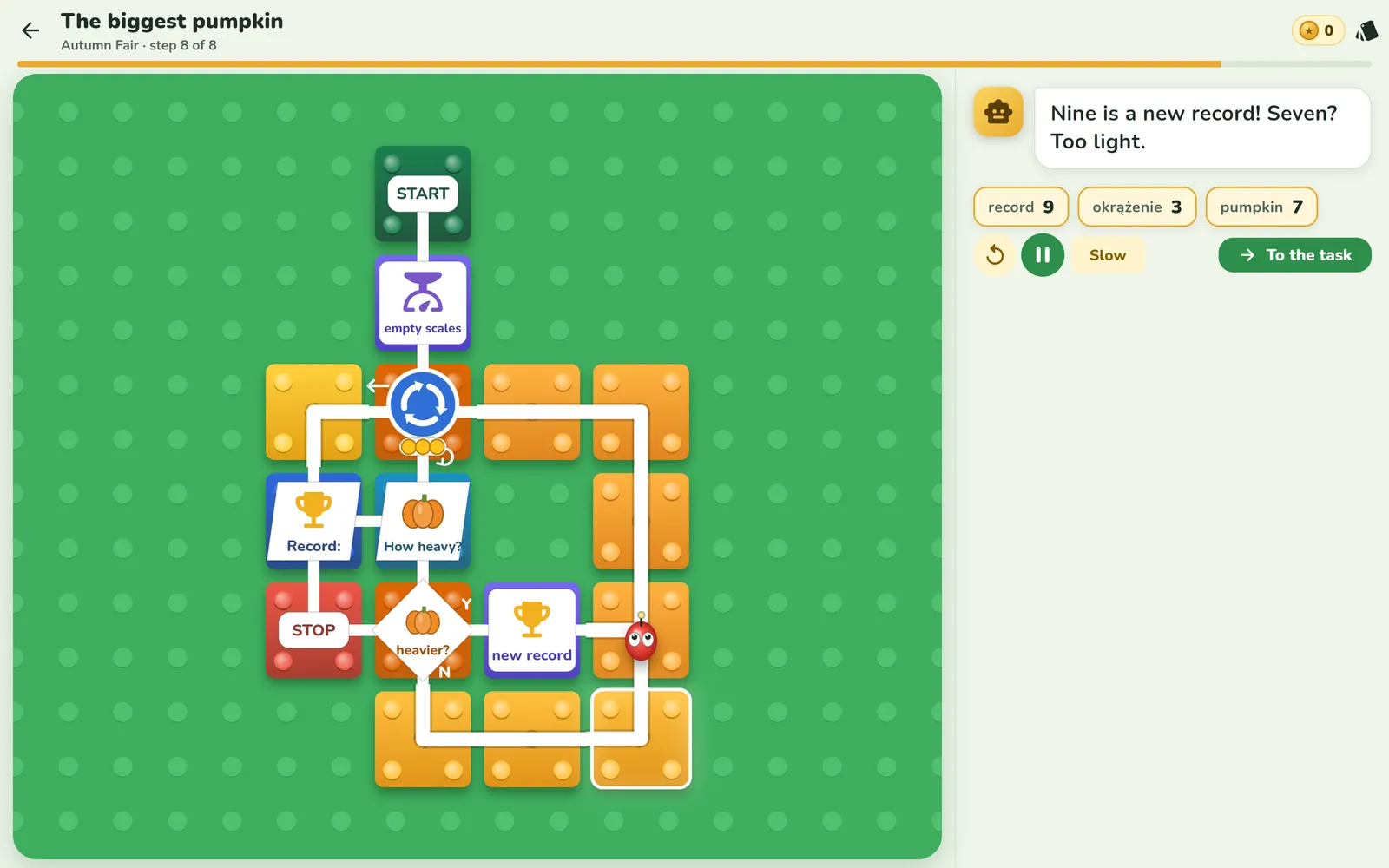
In Looponi a program is a board of blocks joined by a track the child lays out by hand. Before running it, the question is “what will happen?”, and then a glowing token travels through every step. The child isn't guessing — they're checking their own reasoning.
The youngest start with the Little Ones track (grades 1–3): pictures instead of words, dots instead of numbers. By second grade, in the lesson “The biggest pumpkin”, they build a real maximum-finding algorithm — with a loop, a decision and a variable.
Things to watch out for
- Don't do it for them. Asking a question (“what will the token do here?”) beats showing the solution.
- A mistake is information. Instead of “wrong”, say “let's see where the token went a different way”.
- Short and often. A few minutes a day works better than a marathon once a month.
Frequently asked questions
At what age can a child start coding?
A child who is starting to read, usually in first grade, can already lay out simple algorithms. Pictures and the order of steps are enough at first; text-based code comes much later.
Should a 7-year-old learn Python?
Usually not straight away. It pays to build the ideas first — order, decisions, loops and variables — with pictures or blocks. Once they make sense, moving to Python means learning a new notation, not a new way of thinking.
How much time a day should go into learning to code?
Short and regular. A few minutes of a lesson and a little play several times a week does more than one long session now and then.