Flowcharts for kids: how to read and build algorithms
What a flowchart is, what START, STOP, the diamond and the rectangle mean, and how to teach a child to build algorithms step by step. Examples and exercises.
Updated:
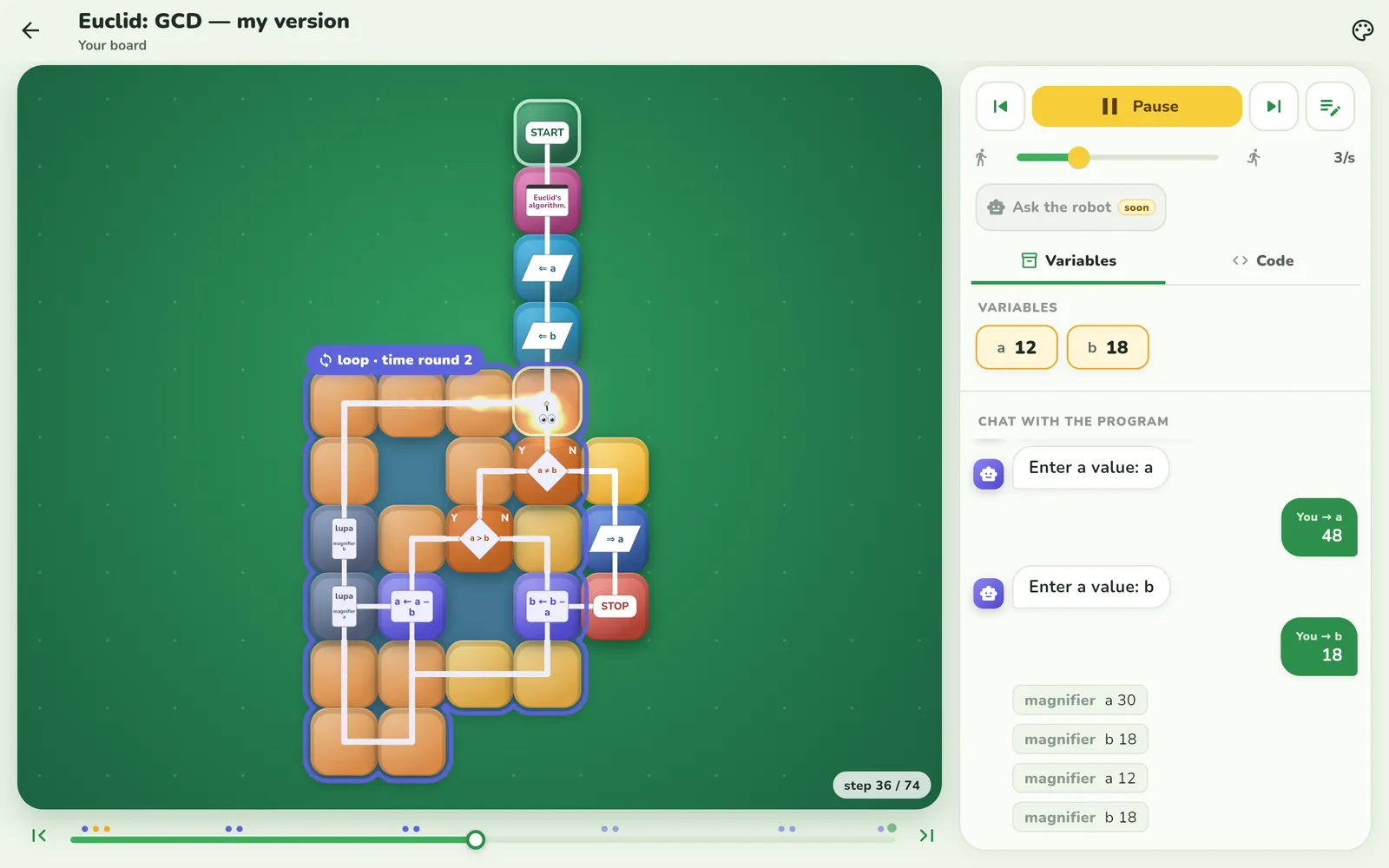
A flowchart is a drawing of an algorithm. Each block is one step, and the arrows show the way the program goes. For a child it's the simplest way to see a program before writing it.
The basic blocks
| Block | Shape | What it does |
|---|---|---|
| START and STOP | rounded | the beginning and end of the program |
| Calculation | rectangle | changes a value, e.g. a ← a − b |
| Input and output | parallelogram | reads data or prints a result |
| Decision | diamond | asks a YES/NO question and splits the path |
How to read a flowchart
Always from START, following the arrows. At a diamond you answer the question and choose a path. If an arrow goes back up, you get a loop — the same part runs again.
A good exercise: before the program runs, the child says what it will print. Then they check. With Euclid's algorithm for 48 and 18 you can predict how many times the loop will go round and what the result will be (GCD = 6).
How to build your own flowcharts
- Start with one sentence: what should the program do?
- List the steps in order, like a recipe.
- Find the places where a decision is needed — that's where the diamond goes.
- Find what repeats — that's the loop, and inside it something has to change so the loop can end.
- Test with several inputs, including the boundaries (e.g. exactly 120 cm if the rule is “from 120”).
A flowchart that runs
In Looponi a flowchart is a board that works: the token travels through the blocks, variables change in front of the child, and a run can be scrubbed like a film. The same board is also written out as Python code, so it's easy to see that the flowchart and the code are two notations for the same algorithm.
Frequently asked questions
What does a diamond mean in a flowchart?
A diamond is a decision. It holds a question whose answer is YES or NO, and two paths leave it — one for each answer.
How is a flowchart different from a Python program?
They show the same algorithm written differently. A flowchart draws the program's path, while code describes it in words. A child who understands the flowchart reads code more easily later.
When do children learn flowcharts at school?
Algorithms in graphic form often appear in the first years of primary school, and classic flowcharts with decisions and loops usually come in the later primary grades.