Why a story
A reason to come back tomorrow.
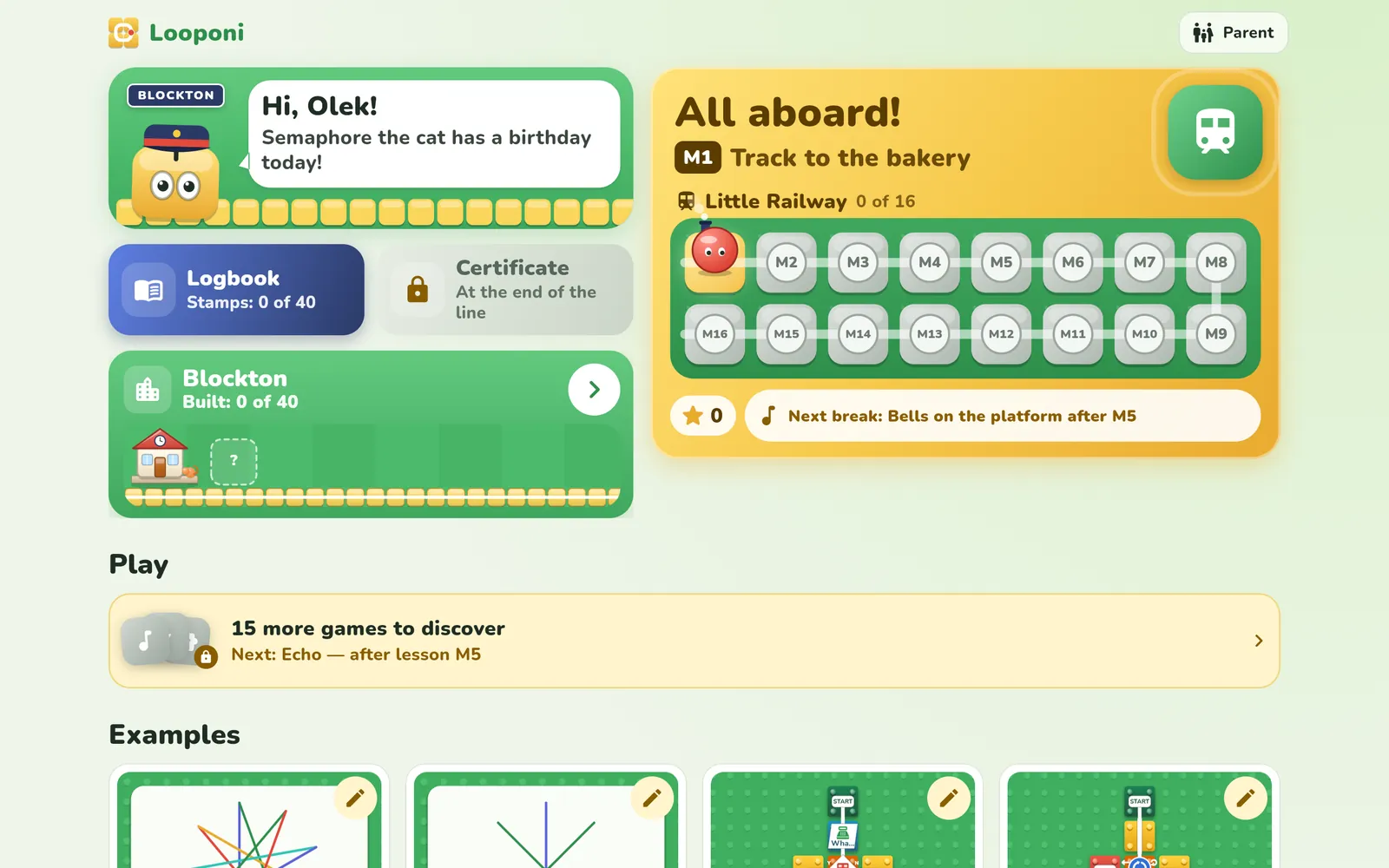
Blockton wants its little railway running again, and every lesson fixes something. The world works exactly like the blocks, so the story doesn't distract from learning, it explains it.
Children lay out a program like a train route, predict what will happen, then watch a token travel through every step. That builds a habit: plan first, then check, and when something doesn't work, find the spot where it goes wrong.
What it teaches
Every idea comes back several times: in pictures for the youngest, then as blocks with conditions, and finally in a real algorithm. Pick an idea or keep scrolling.
How it teaches
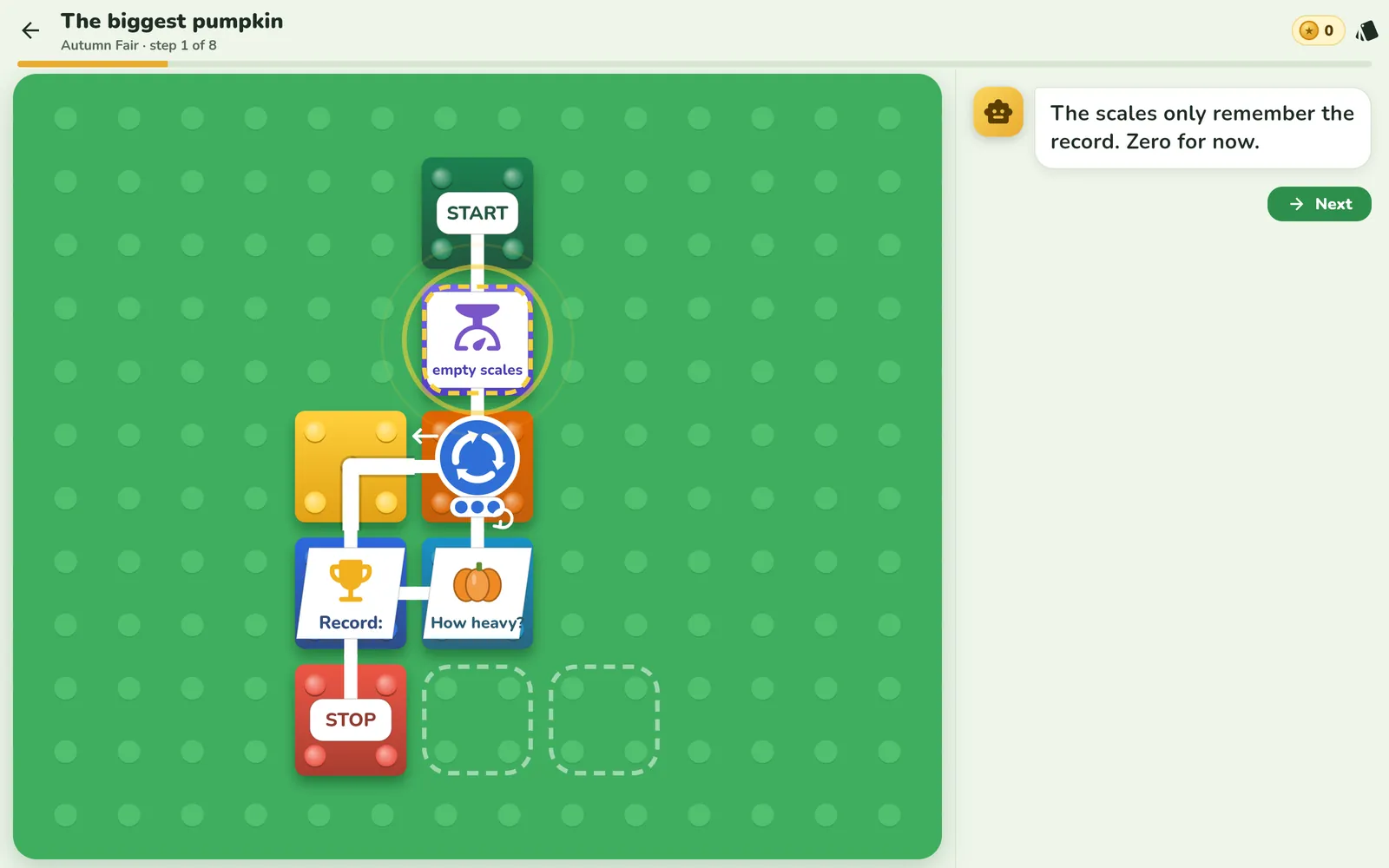
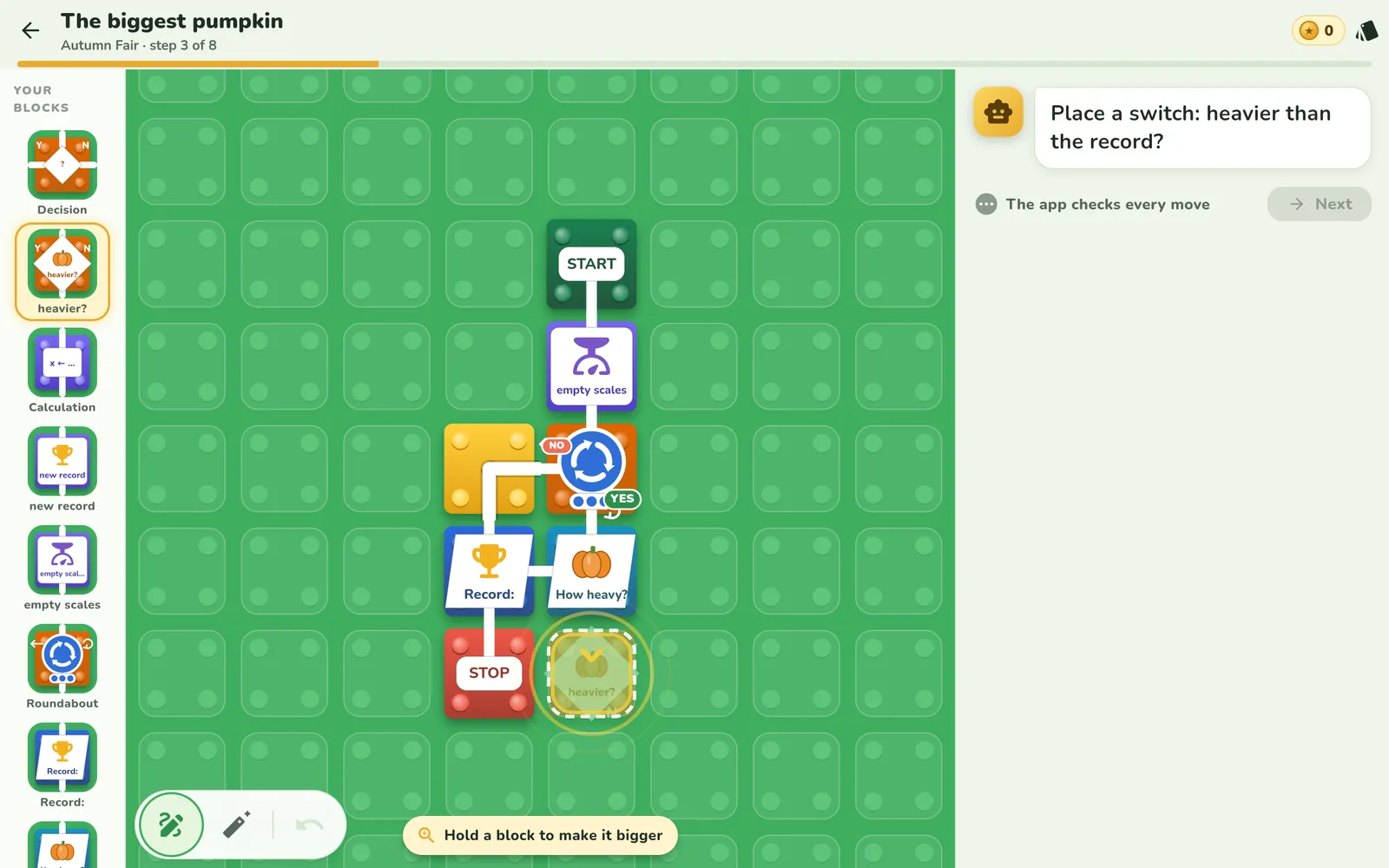
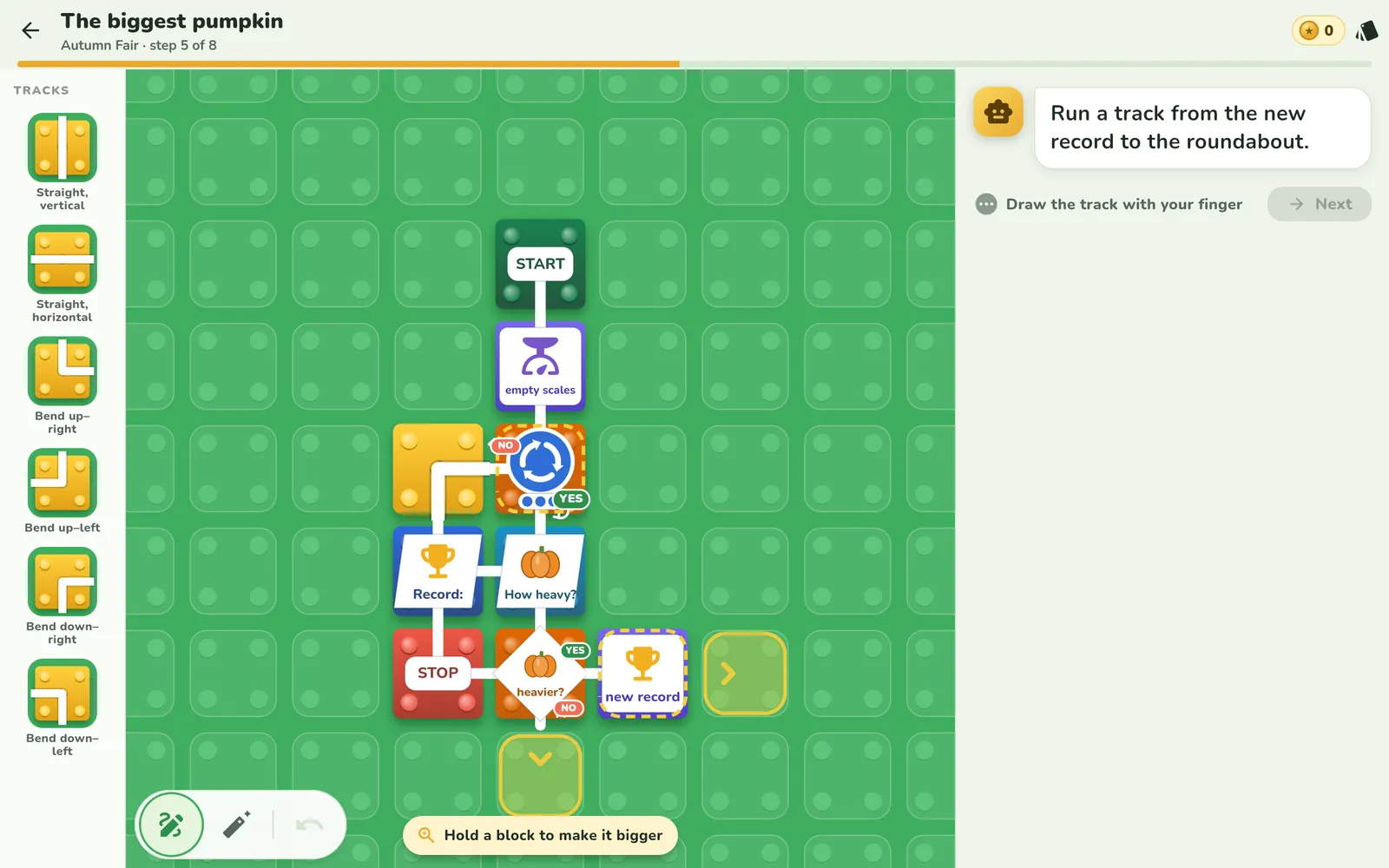
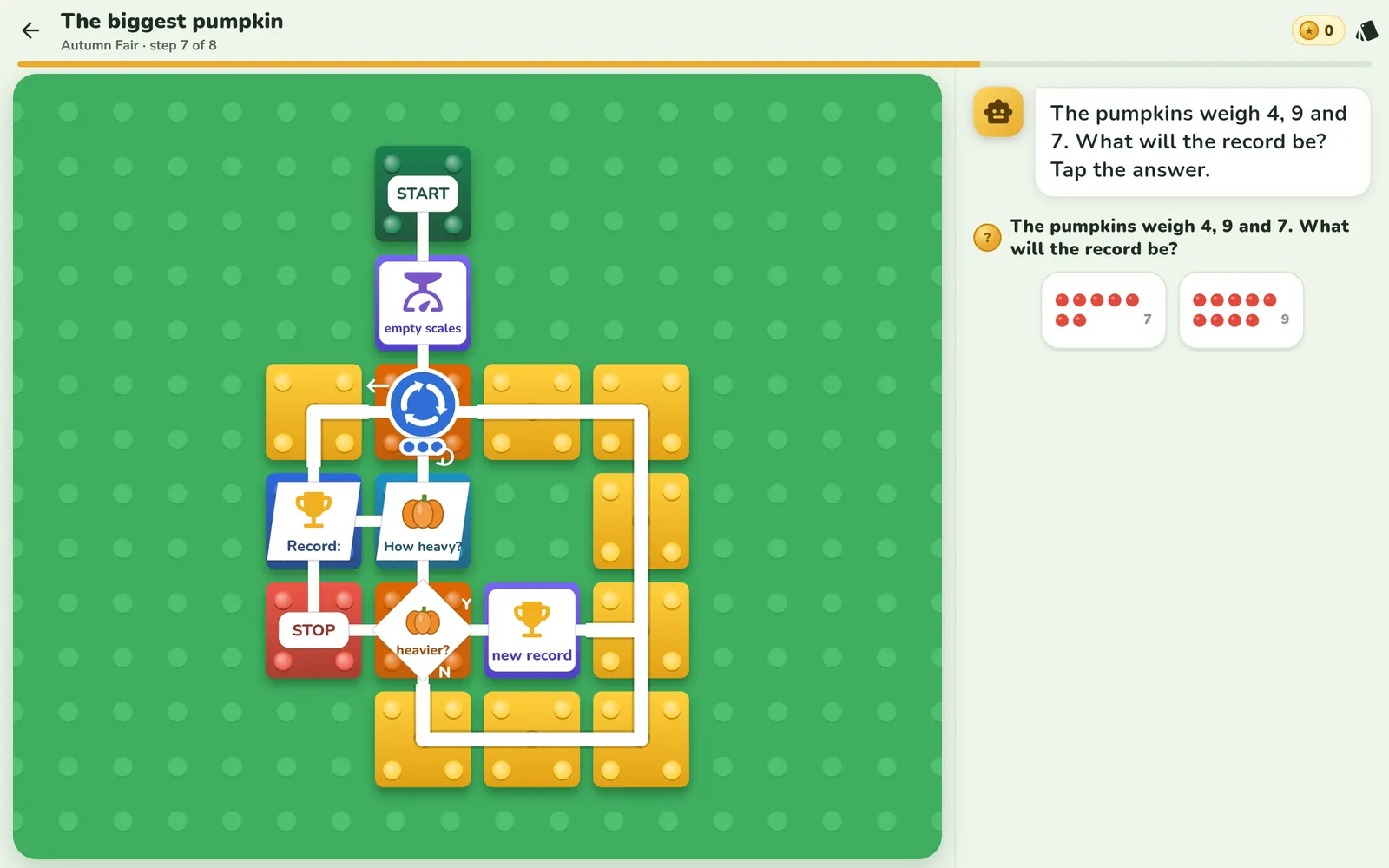
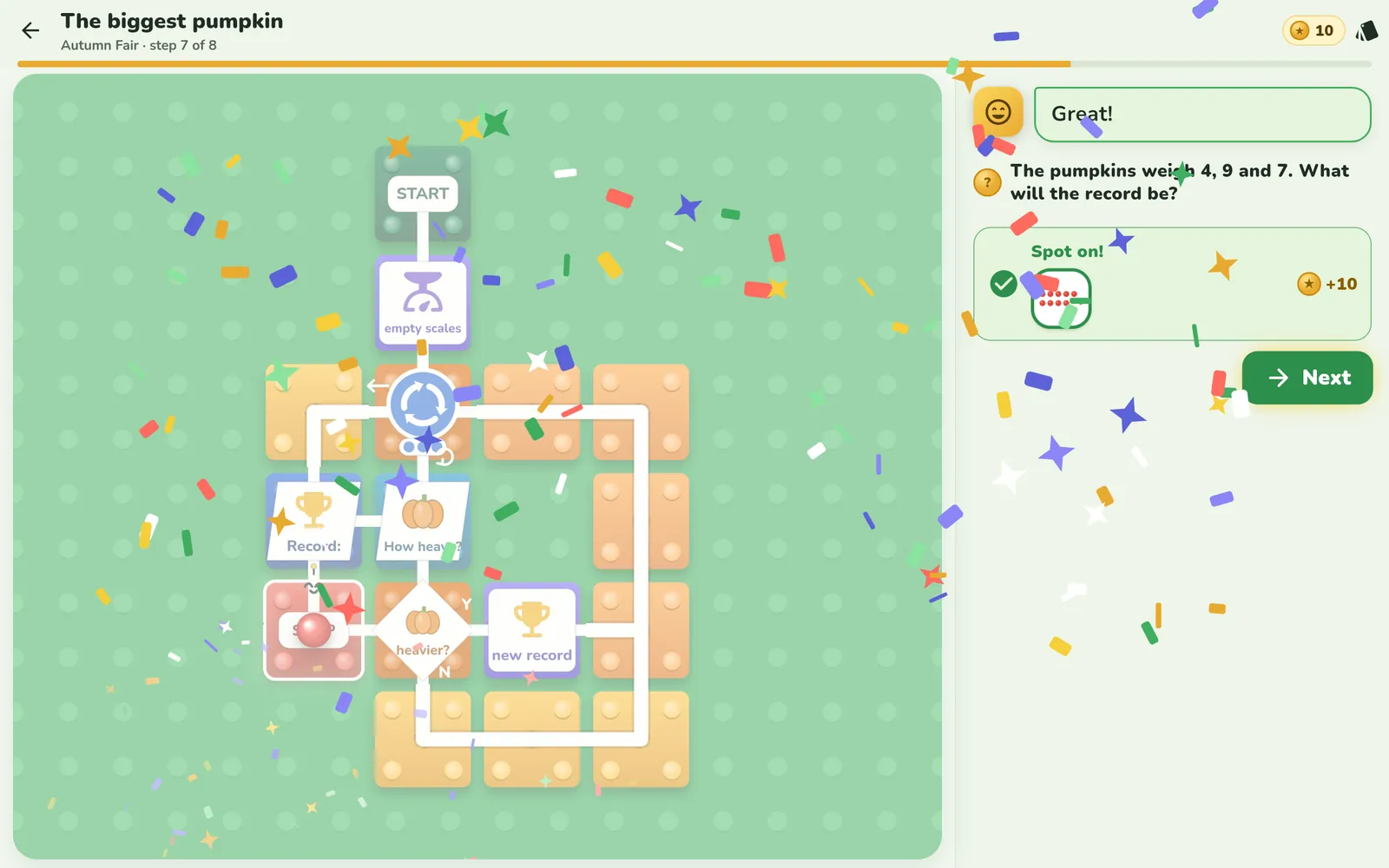
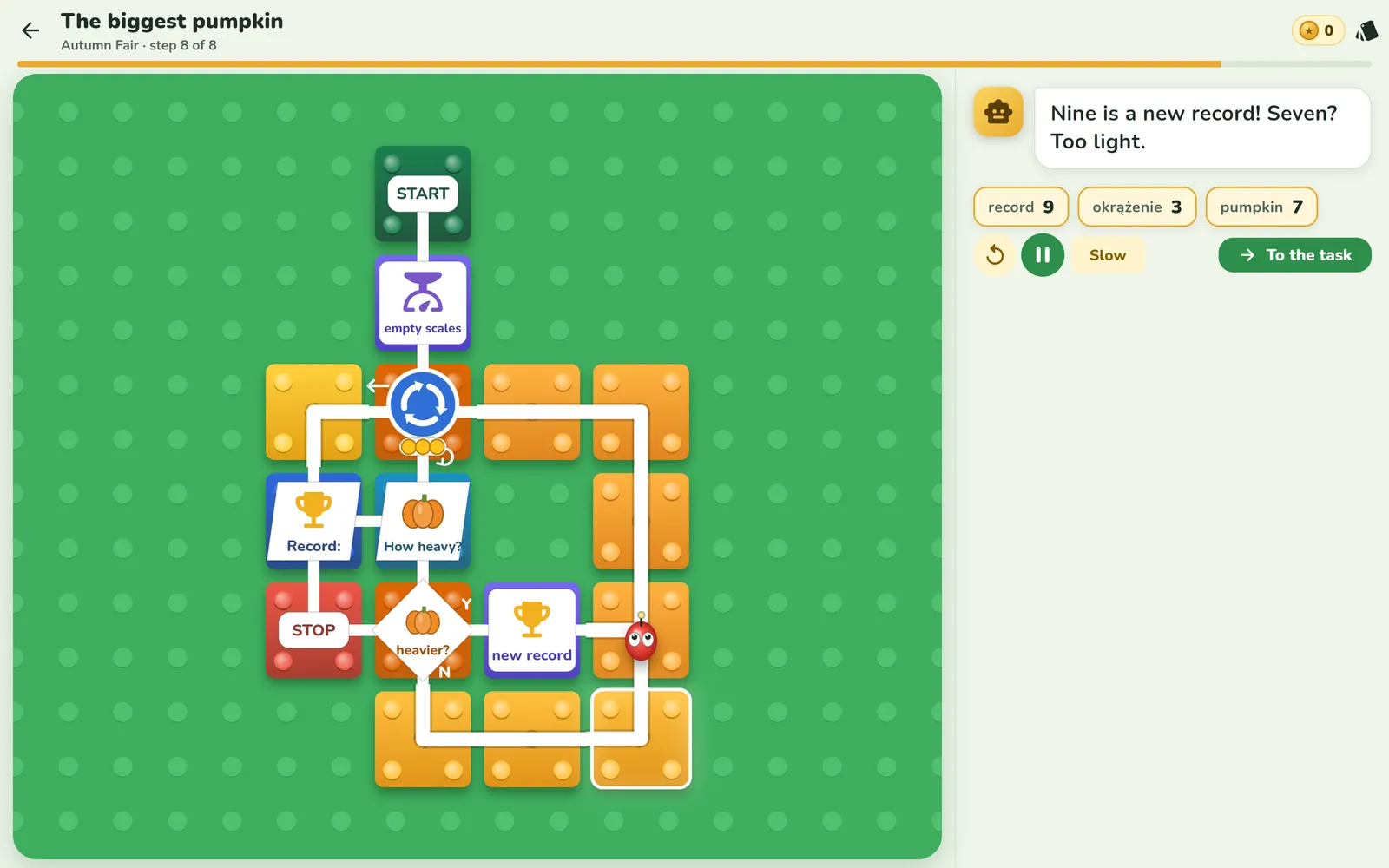
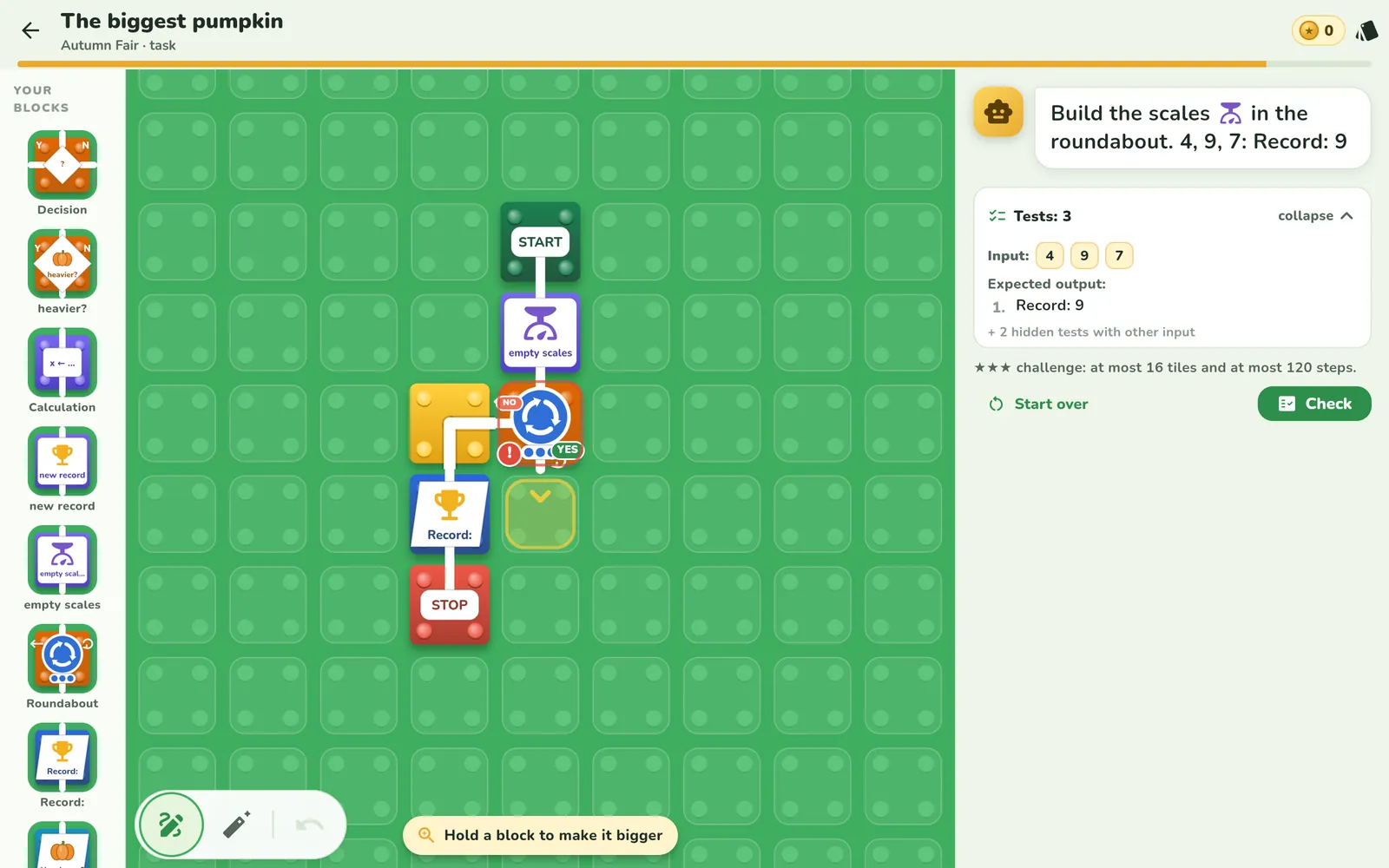
The lesson “The biggest pumpkin” from the Autumn Fair: pumpkins are weighed one by one in a roundabout, and a switch asks whether each one is heavier than the record. A loop, a decision and a variable, built from pictures. Every lesson follows the same rhythm.

ideaThe scales remember only the record, zero for now. That's the first variable.

build with meAn outline shows where to place the switch: heavier than the record?

connectThe track from “new record” goes back to the roundabout. That's how a loop is made.

predict“The pumpkins weigh 4, 9 and 7. What will the record be?” The answer comes before the run.

checkCorrect: 9. Predicting is half of thinking.

watch“Nine is a new record! Seven? Too light.” You can see the laps and the record.

on your ownA task from scratch. The app checks three sets of pumpkins, not whether the board looks like a model answer.
When something goes wrong
That's how the track for grades 1–3 guides the youngest. Older children get hints from the tutor, stepped the same way.
Repeats so it sticks
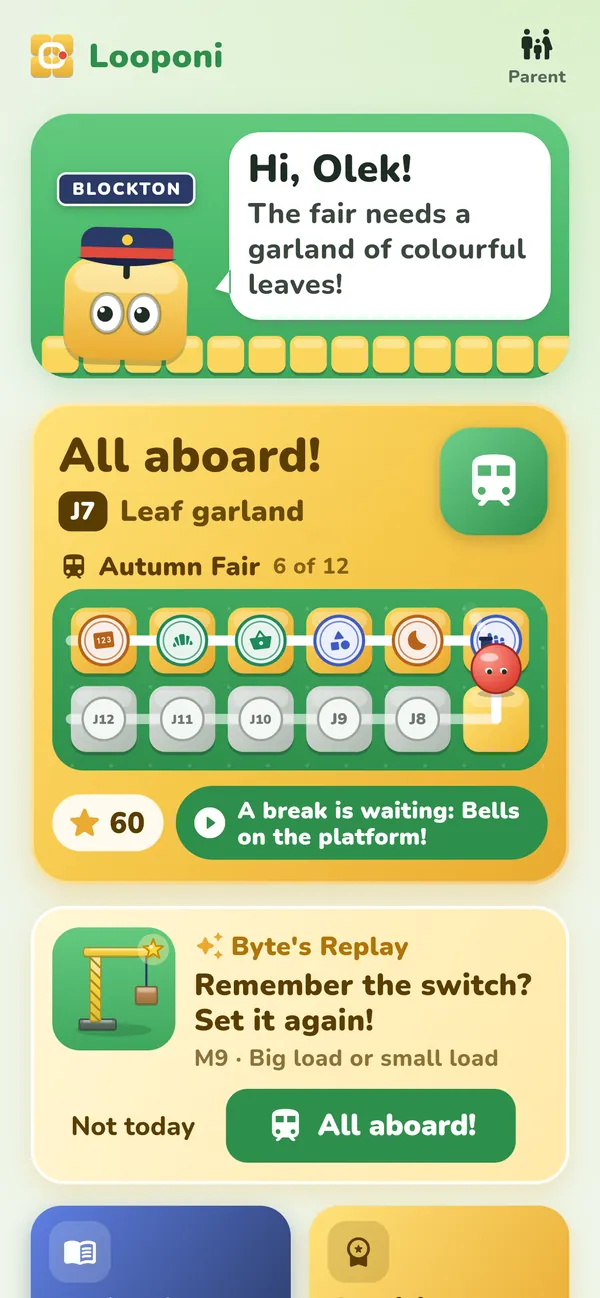
Byte's Replay is just the task from a lesson a few days ago, with no hints. A success pushes the next one further away, a miss brings it back sooner. That's spaced practice: knowledge lasts longer than after a single go.
Didn't work out? The task comes back after 2 days. Parents can turn reviews off.

Sees how much they know
A completed lesson leaves a building, bridge or station in Blockton, stamped with that lesson. New districts emerge from the mist, and every route adds a carriage. Progress is a place the child has built, not a percentage on a bar.
Builds a loop
In the lesson “Countdown 10…1”, the child lays the most important pipe: from the bottom of the loop back up to the decision. Then they guess how many times the loop will go round, and watch its tiles heat up with every turn.
Predicts, then checks
That question comes before the run. Then the program shows what really happens: the token glides along the tracks and the loop tiles heat up with every lap. The child isn't guessing, they're checking their own reasoning.
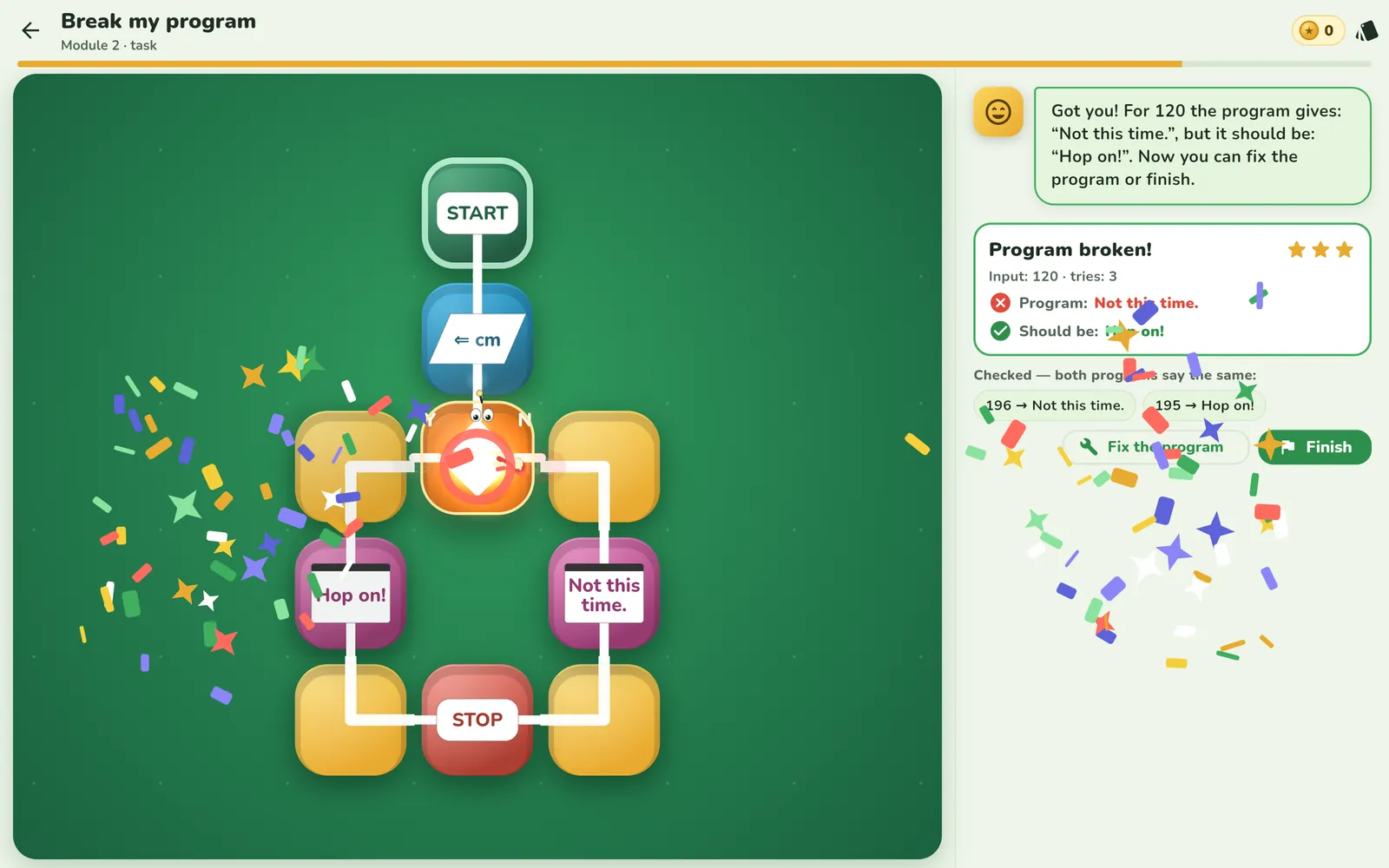
Hunts for the bug instead of giving up
A run can be scrubbed like a film. Variables rewind along with the token, so you can see the exact step where a value stopped adding up. A bug is a place on the board, not a red “wrong”.
Tests like a programmer
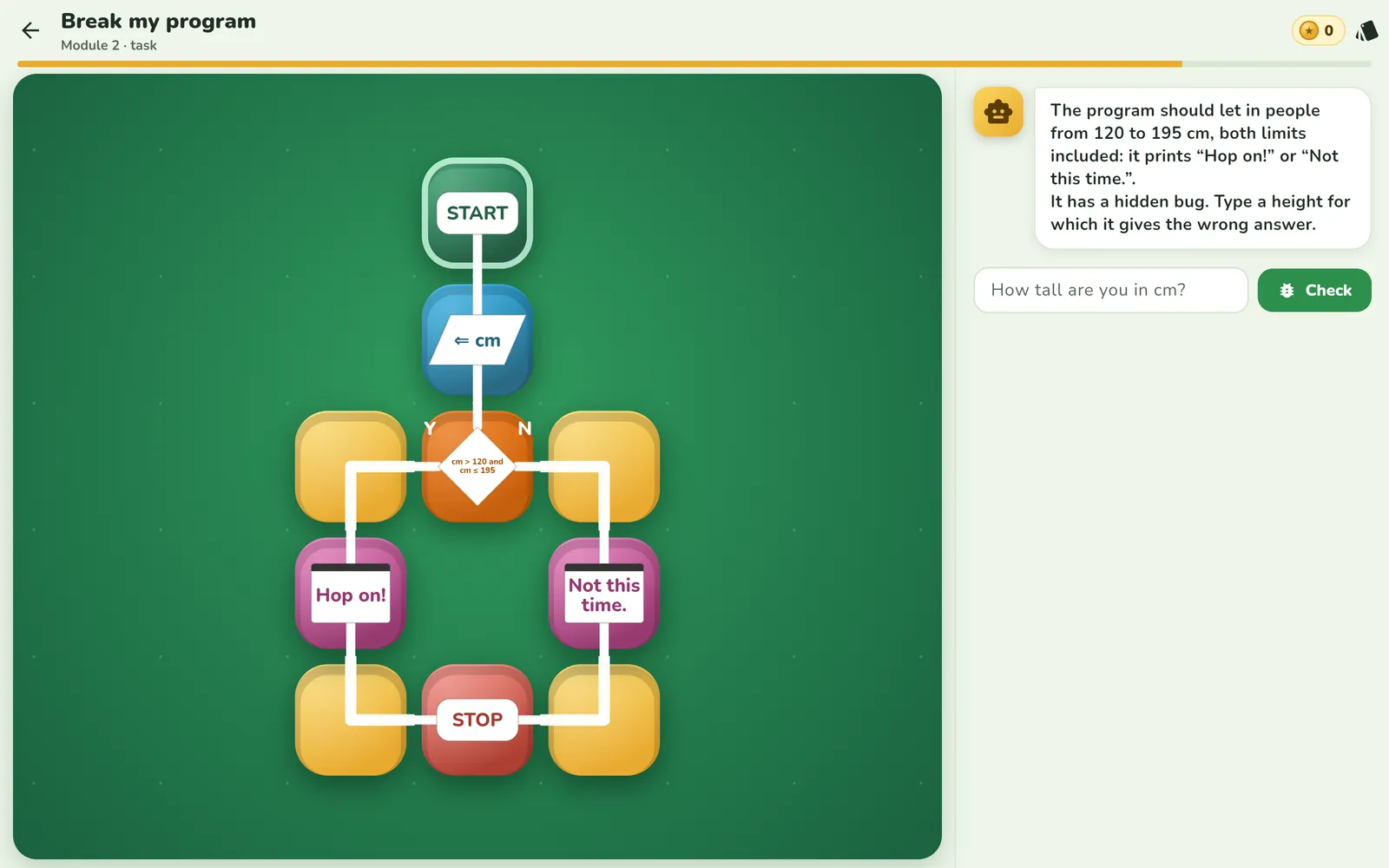
The program is finished but has a hidden bug. The job is to find an input it gets wrong. The middle and the extremes work, so a tester looks where the program changes its mind: at the boundaries.


Understands how a machine learns
In the break game “Guess what I'm thinking of”, Byte asks YES/NO questions. When he gets it wrong, he asks what makes it different and adds a new diamond to the flowchart himself. The child sees that this kind of “artificial intelligence” is also an algorithm, just one built from examples.
Maths you can see
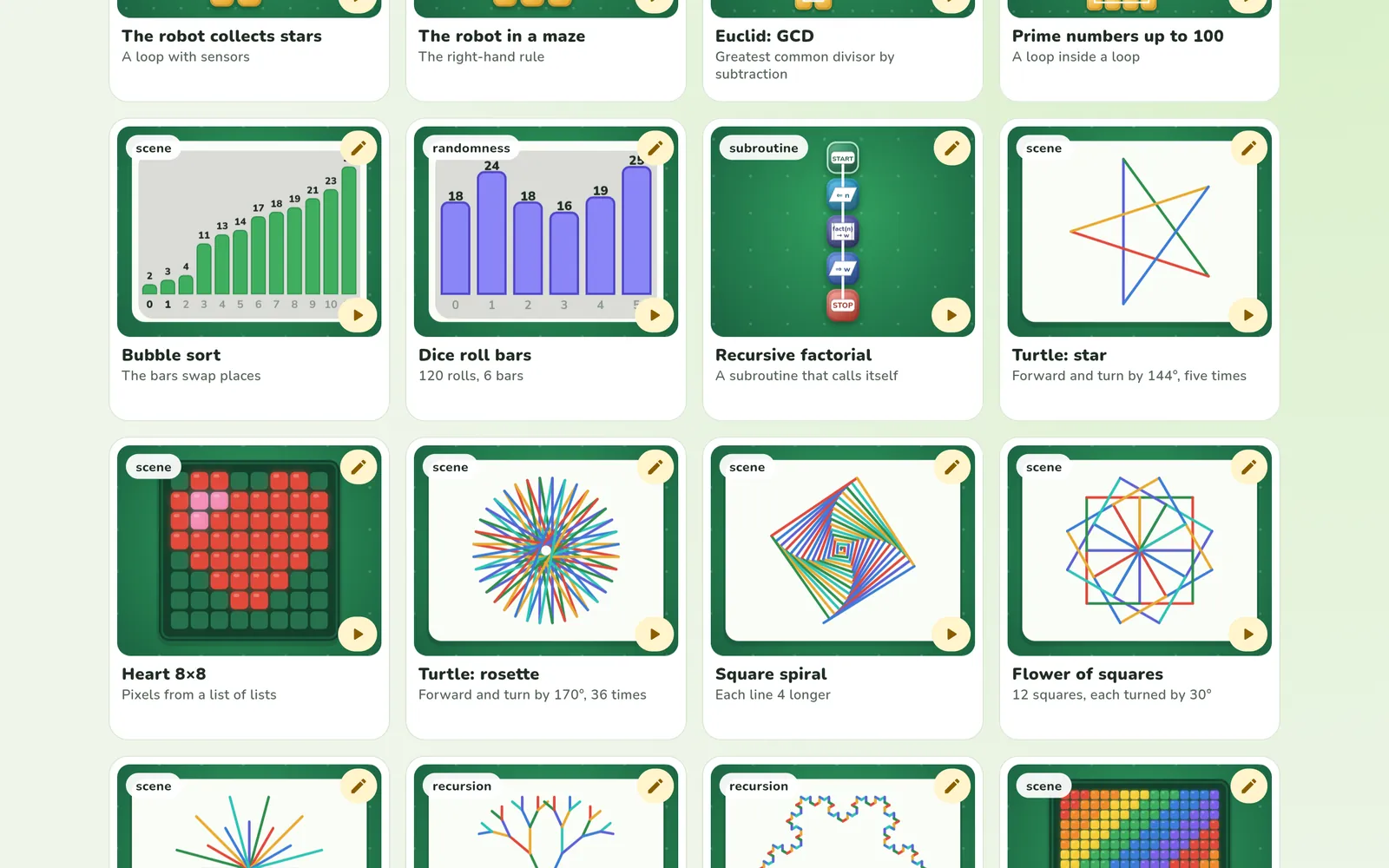
Examples that draw: a rosette, a square spiral, a Koch snowflake, rainbow pixels. Each one is a handful of blocks to take apart and remix.

Why a story
Blockton wants its little railway running again, and every lesson fixes something. The world works exactly like the blocks, so the story doesn't distract from learning, it explains it.
Practises in the breaks
A break lasts 1–3 minutes and sits on the map right after the lesson it belongs to. Parents set a daily limit.
Grows with the child
Parents pick a track by age. Younger children ride along with a story and pictures, older ones get the full course and Python code. Those who know the basics can start further on: a placement test lets them skip modules they already know.
Pupils plan projects “by describing algorithms in words, graphically, and using block-based programming apps”.Poland's new core curriculum for grades 1–3 (Dz.U. 2026 item 378), computing education — our translation
A bridge to real code

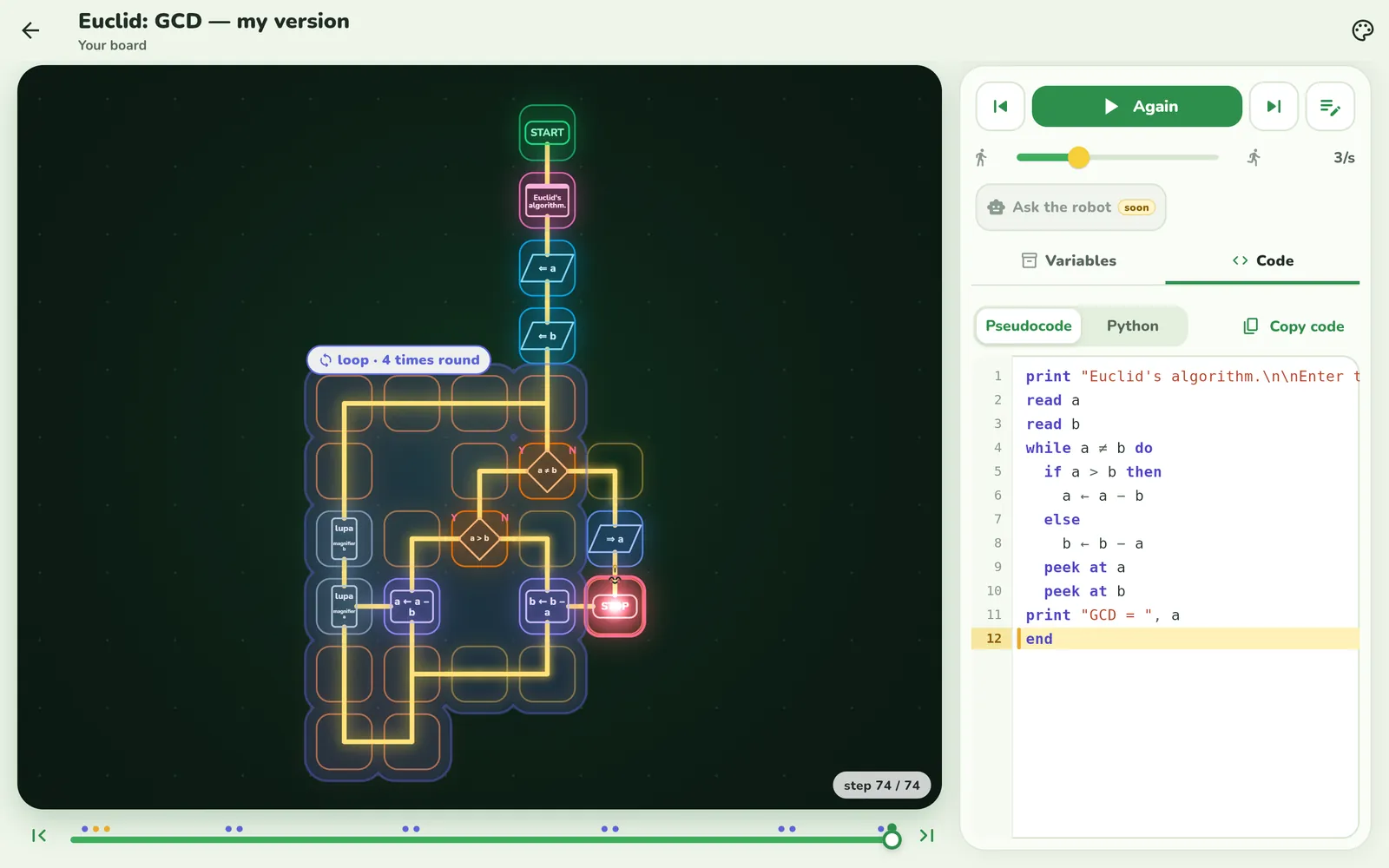
This is how Looponi writes the same board in Python. The current line lights up together with the token, so the code reads like a route the child already knows.
A reward for progress
Eleven board styles: chalk on a blackboard, video-game pixels, neon, and the newest, Model railway, with wooden tiles and a little smoking engine. Same program, new fun.
For parents
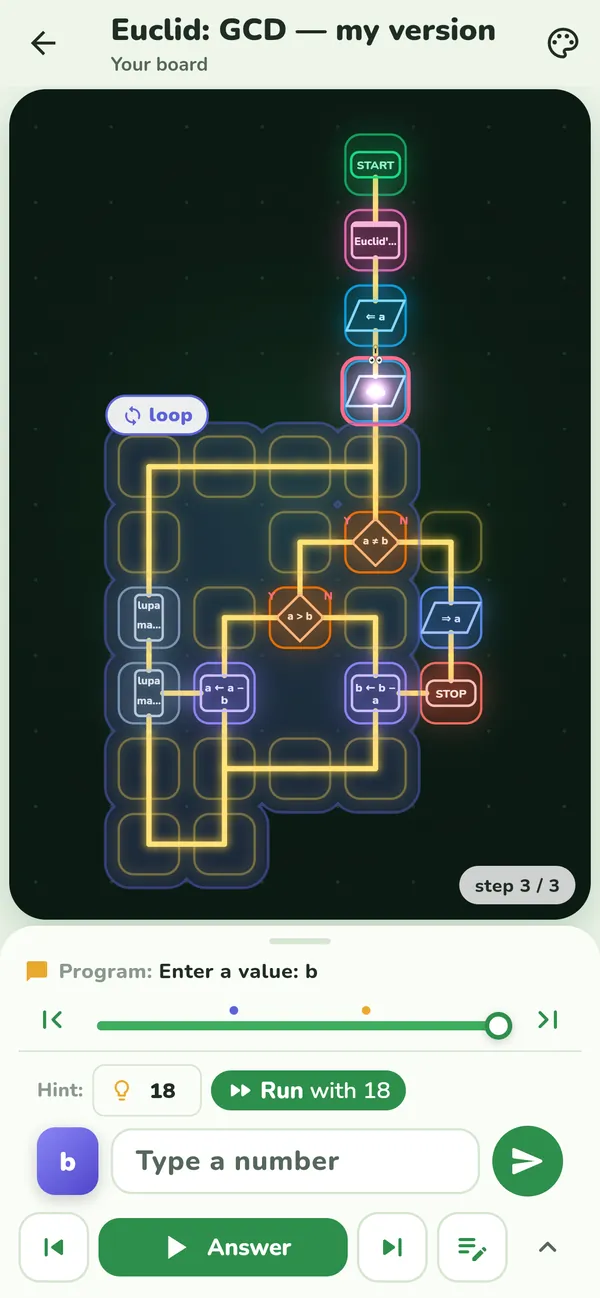
For older children, the tutor first asks a question, then points to a tile, and only then gives a fragment. Never the whole solution. The youngest don't have it at all.
A mistake ends with a hint about what to fix, not a penalty.
The age track, the child's name, the daily play limit and reviews. Settings are protected by a PIN.
Lessons and boards work offline. Only the tutor and the cloud need the internet.
A guide for parents
From first grade, when a child starts to read. The youngest get the Little Ones track with pictures, older children a course that goes all the way to recursion and Python, and adults can unlock every lesson at once.
Yes. No ads and no in-app purchases.
Android phones and tablets, and in the browser. Lessons and boards work offline.
No. Lessons, mini-games and boards work without an account. An account is useful for saving boards to the cloud.
Polish, English, German and French. Narration is in Polish only.
The lessons for grades 1–3 practise what Poland's new core curriculum asks for: algorithms in graphic form, block-based programming and a robot on a route.